Private equity firms, M&A advisors, investors, and deal teams often move quickly when evaluating a potential transaction. Before signing, funding, or closing, they need to understand more than the financial position of a target company. They also need to understand the public-record and reputational risk surrounding the business, its owners, sellers, executives, and other key individuals.
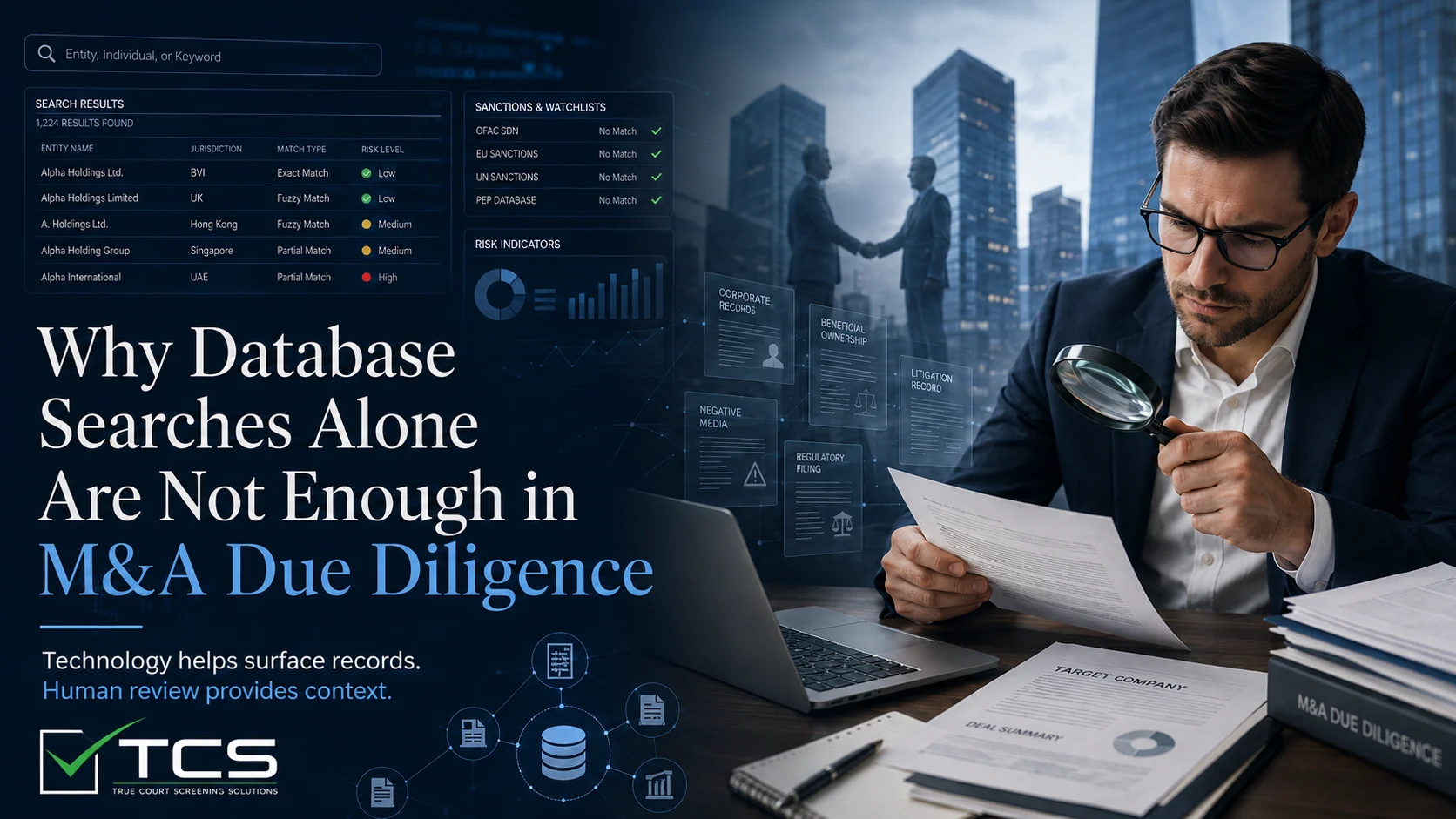
Database searches can play an important role in that process. They provide fast access to information such as corporate records, litigation indexes, bankruptcy filings, judgment liens, UCC filings, sanctions data, watchlists, and adverse media. These tools are useful because they help identify potential issues quickly and can guide the next step in the review process.
However, database searches should not be mistaken for complete due diligence. In M&A, the difference between finding data and understanding risk can be significant.
Database Searches Are a Starting Point
Aggregator databases and commercial screening platforms are designed to collect information from multiple sources and make that information searchable in one place. For deal teams, this can be valuable during the early stages of review. A search may surface records tied to a target company, seller, founder, executive, affiliated entity, or related party. It may also identify possible litigation, liens, bankruptcies, corporate registrations, sanctions exposure, adverse media, or business name variations.
The challenge is that database results are only as strong as the information behind them. Some public records are not updated in real time. Some jurisdictions have limited online access. Certain court records, filings, or local documents may not be included in commercial databases at all. In other cases, a record may appear in a database but lack enough detail to determine whether it is accurate, current, or relevant.
The Limits of Database-Only Due Diligence
This creates risk in an M&A setting. A database may return a litigation record, but it may not explain the nature of the case, the parties involved, the current status, or whether the matter is material to the transaction. A lien or UCC filing may appear, but additional review may be needed to understand whether it reflects ordinary business financing, a significant debt issue, or a concern tied to assets or obligations. A bankruptcy record may surface, but further analysis may be needed to determine whether it relates to the correct individual, an affiliated business, or an unrelated party with a similar name.
Adverse media can create similar challenges. A negative article may be outdated, duplicated across sources, taken out of context, or not actually connected to the subject of the review. The reverse can also happen. A database may return no obvious records, but that does not always mean no risk exists. It may simply mean the issue was not captured by that database.
For high-stakes transactions, this can create a false sense of security.
Why Context Matters in Private Equity and M&A
In private equity and M&A due diligence, context matters because findings can affect how a deal is viewed, negotiated, structured, or approved. A lawsuit is not automatically a deal issue, but a pattern of litigation involving fraud, contract disputes, regulatory matters, employment claims, or undisclosed business conflicts may require closer attention. A judgment lien may not always be material, but if it suggests financial distress, creditor issues, or undisclosed obligations, it may change the risk profile of the transaction. A UCC filing may be routine, but it may also point to financing arrangements, secured obligations, or collateral interests that should be better understood before closing.
This is where human-led due diligence becomes important. The goal is not simply to identify that a record exists. The goal is to determine whether the record is accurate, connected to the right person or entity, relevant to the transaction, and meaningful enough to escalate.
Human Review Helps Turn Records Into Risk Insight
Human review adds verification, judgment, and interpretation to the process. An experienced reviewer can look beyond the first database result and ask the right follow-up questions. Is the record tied to the correct company or individual? Are there name variations, prior business names, aliases, or related entities that should also be reviewed? Does the record reflect a current issue or an old matter with limited relevance? Was the case dismissed, settled, reduced to judgment, or still pending? Does the issue create legal, financial, reputational, regulatory, or operational concern?
This type of review is especially important when evaluating acquisition targets, sellers, founders, owners, executives, board members, and key operators. These individuals and entities can influence not only the deal itself, but also the future performance, reputation, and risk exposure of the acquired business.
Combining Database Resources With Human-Led Due Diligence
The strongest due diligence process combines the speed of database searches with the judgment of human review. Technology helps identify possible records quickly. Human review helps determine whether those records matter. This approach helps reduce false positives, identify missed issues, and provide a more useful review for decision-makers.
At True Court Screening Solutions, our due diligence reviews are tailored around the transaction, the risk level, and the specific questions the client needs answered. Depending on the scope, reviews may include business entity verification, civil litigation research, bankruptcy records, judgment liens, UCC filings, sanctions and watchlist screening, adverse media review, professional license verification, ownership research, and key person background research.
When a Basic Search May Be Enough
Not every matter requires a full due diligence review. For early-stage screening, low-risk opportunities, or preliminary internal review, a targeted database search may be sufficient. However, when the matter involves a meaningful acquisition, investment, ownership transition, executive evaluation, partnership, or high-value business relationship, a deeper review is often warranted.
The higher the risk, the more important it becomes to verify records, review source information where available, and understand the context behind the findings.
Due Diligence Should Support Better Decisions
M&A due diligence is not about checking boxes. It is about helping decision-makers understand risk before commitments are made. Database searches are valuable tools, but they do not replace analysis. They can show that something may exist, but they do not always explain what it means, whether it is complete, or whether it should influence the transaction.
For private equity firms, M&A advisors, investors, and deal teams, public-record and reputational due diligence should go beyond surface-level screening. At True Court Screening Solutions, we help clients combine data-driven research with human-led review to provide more practical, relevant, and defensible due diligence support.
When the decision matters, due diligence should not stop at the database.