Before entering a business relationship, it is easy to rely on what is visible on the surface. A company may have a professional website, polished marketing materials, positive references, and a strong sales pitch.
But those items do not always tell the full story.
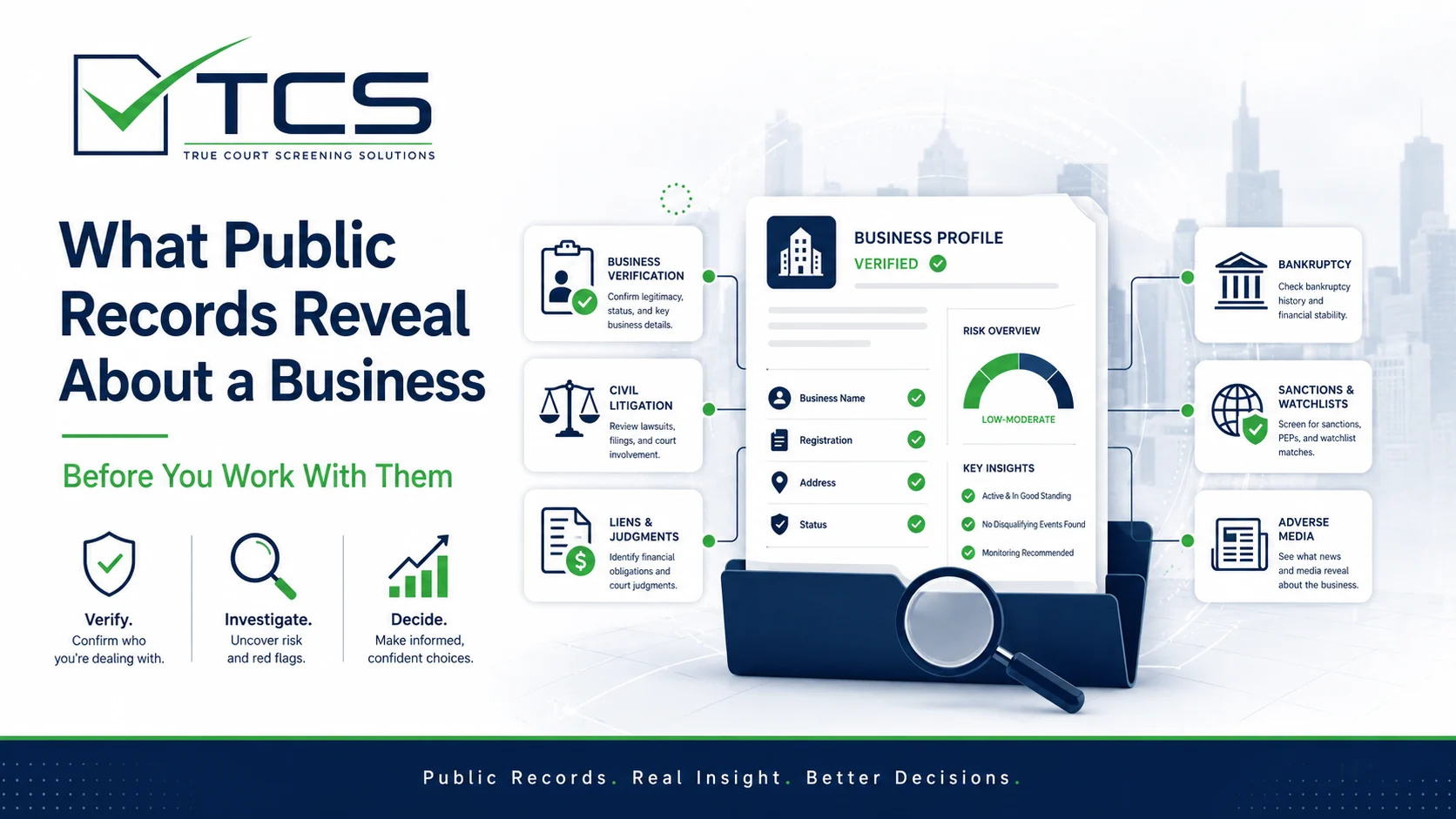
Public records can reveal important information about a business, its owners, executives, financial history, litigation activity, and potential risk indicators. For companies evaluating vendors, contractors, partners, acquisition targets, suppliers, or other third parties, public-record research can be a valuable part of the due diligence process.
The goal is not to look for problems where none exist. The goal is to make more informed decisions before a business relationship begins.
Why Public Records Matter in Business Decisions
Every business relationship carries some level of risk. A vendor may have access to company systems, customer information, facilities, financial processes, or confidential data. A business partner may impact reputation, operations, or future growth. An acquisition target may come with hidden liabilities that are not obvious during initial discussions.
Public records can help identify information that may not appear in a proposal, website, or reference call.
These records may help answer questions such as:
- Is the business properly registered and active?
- Has the company been involved in repeated lawsuits?
- Are there liens, judgments, or bankruptcy records?
- Do the owners or executives have public-record issues that may be relevant?
- Are there sanctions, watchlist, or adverse media concerns?
- Does the available information support the company’s representations?
Public records do not replace legal, financial, or operational due diligence, but they can provide important context before a company moves forward.
Business Registration and Entity Verification
Business Registration and Entity Verification
One of the first steps in reviewing a business is confirming that the entity exists and is properly registered.
Business registration records can help verify the legal name of the company, its status, formation date, registered agent, principal address, and sometimes ownership or management information, depending on the jurisdiction.
This can be important because some companies operate under trade names, assumed names, DBAs, or affiliated entities. Without confirming the correct legal entity, a company may not know exactly who it is entering into an agreement with.
Entity verification can help identify:
- Whether the business is active or inactive
- Whether the company name matches the contract or proposal
- Whether the business is newly formed
- Whether the company operates under a DBA or related entity
- Whether the registered address or agent information raises questions
This is a basic but important part of understanding who you are dealing with.
Civil Litigation and Court Records
Civil litigation records can provide insight into a company’s history of disputes. These may include lawsuits involving contracts, unpaid invoices, business disagreements, negligence claims, employment disputes, customer complaints, or partnership conflicts.
A single lawsuit does not automatically mean a company is high-risk. Many businesses become involved in litigation at some point. However, repeated lawsuits or similar patterns of claims may be worth reviewing more closely.
For example, multiple lawsuits involving breach of contract, unpaid vendors, collections, or customer disputes may indicate operational or financial concerns. Litigation involving fraud, misrepresentation, or misconduct may raise reputational or business risk questions.
Civil court records can help companies better understand whether litigation history appears isolated or whether it reflects a broader pattern.ous problem. However, repeated issues or a pattern of similar concerns may be important when evaluating risk.
Liens, Judgments, and UCC Filings
Financial public records can also reveal important business risk indicators.
Liens may indicate that a creditor, government agency, or other party has a legal claim against a business or its property. Judgments may show that a court has entered a financial decision against the company. UCC filings may show that a lender or creditor has a secured interest in certain business assets.
These records do not always mean a business should be avoided. Many businesses have financing arrangements, secured obligations, or prior disputes. However, they can help identify financial pressure, creditor activity, unresolved obligations, or assets that may already be pledged as collateral.
When viewed in context, these records can help decision-makers understand whether there may be financial concerns that require further review.
Bankruptcy Records
Bankruptcy records can reveal whether a business or related individual has filed for bankruptcy protection.
A bankruptcy filing does not always mean a business is unreliable. In some cases, bankruptcy may be part of a restructuring process or an older issue that has since been resolved. However, bankruptcy history may still be relevant when evaluating financial stability, vendor reliability, acquisition risk, or long-term partnership decisions.
Bankruptcy records may help identify:
- Prior business financial distress
- Current bankruptcy proceedings
- Related entities or individuals involved in bankruptcy matters
- Creditors, claims, or restructuring activity
- Potential financial or operational concerns
As with other public records, context matters. The date, outcome, parties involved, and current status of the matter are all important.
Sanctions, Watchlists, and Compliance Concerns
VFor certain business relationships, sanctions and watchlist screening may be an important part of due diligence.
These searches can help identify whether a company, owner, executive, or related party appears on government sanctions lists, watchlists, politically exposed person lists, or other compliance-related databases.
This can be especially important for companies involved in financial services, international business, investments, lending, supply chains, regulated industries, or higher-risk vendor relationships.
Sanctions and watchlist screening can help reduce exposure to compliance, regulatory, reputational, and business risk.
Adverse Media and Reputational Risk
Not all relevant risk appears in court records or official filings. Adverse media research can help identify public reporting involving fraud allegations, regulatory issues, business disputes, misconduct, safety concerns, consumer complaints, or other reputational matters.
Adverse media does not prove wrongdoing by itself. News coverage, online articles, and public reports should be reviewed carefully and placed in context. However, adverse media can help identify issues that may require additional questions before a business relationship begins.
For example, a company may not have a major court record history, but may still have a pattern of negative reporting involving poor business practices, failed projects, regulatory scrutiny, or customer harm.
That information may be important when evaluating risk.
Why Context Matters
Public records are most useful when they are reviewed with context.
One lawsuit, lien, or news article may not be significant by itself. But several records involving similar issues may tell a different story. A business with one old contract dispute is different from a business with repeated lawsuits, unpaid judgments, bankruptcy filings, and negative media.
The purpose of public-record due diligence is not to automatically reject a business because a record exists. The purpose is to understand the nature, timing, severity, and pattern of the findings.
Good due diligence helps separate minor or explainable issues from meaningful risk indicators.
Why Basic Online Searches Are Not Enough
A basic internet search can be helpful, but it is rarely enough for meaningful business due diligence.
Search engines may miss court records, state filings, liens, bankruptcies, UCC records, or older adverse media. Search results may also be incomplete, outdated, or mixed with unrelated companies and individuals that share similar names.
Public-record research often requires reviewing multiple sources, confirming identifiers, and understanding how different records connect to the correct business or person.
This is where structured research and human review become important.
How True Court Screening Solutions Can Help
How True Court Screening Solutions Can Help
True Court Screening Solutions helps businesses, investors, advisors, and organizations review public records before entering important business relationships.
Depending on the scope of the request, our research may include business entity verification, civil litigation searches, criminal public records where appropriate, bankruptcy records, judgments and liens, UCC filings, sanctions and watchlist screening, adverse media research, and other public-record checks.
Whether you are evaluating a vendor, contractor, business partner, acquisition target, executive, or other third party, public-record due diligence can help provide a clearer picture before decisions are made.
Public records may not tell the entire story, but they can reveal information worth knowing before you move forward.