
Before entering a business relationship, most companies review what is immediately visible. They look at the website, speak with the sales team, review the proposal, check references, and maybe do a quick online search.
Those steps are helpful, but they rarely tell the full story.
A business can look professional on the surface while still carrying risk beneath it. There may be litigation history, financial warning signs, ownership concerns, adverse media, regulatory issues, or other indicators that are not obvious during the normal sales or onboarding process.
That is where investigative due diligence can make a difference.
Investigative due diligence helps businesses look beyond surface-level information and review public records, court history, financial risk indicators, reputational concerns, sanctions exposure, and other information that may be relevant before entering a vendor, contractor, partner, executive, supplier, or acquisition relationship.
The goal is not to find reasons to say no. The goal is to understand who you are dealing with before you sign.
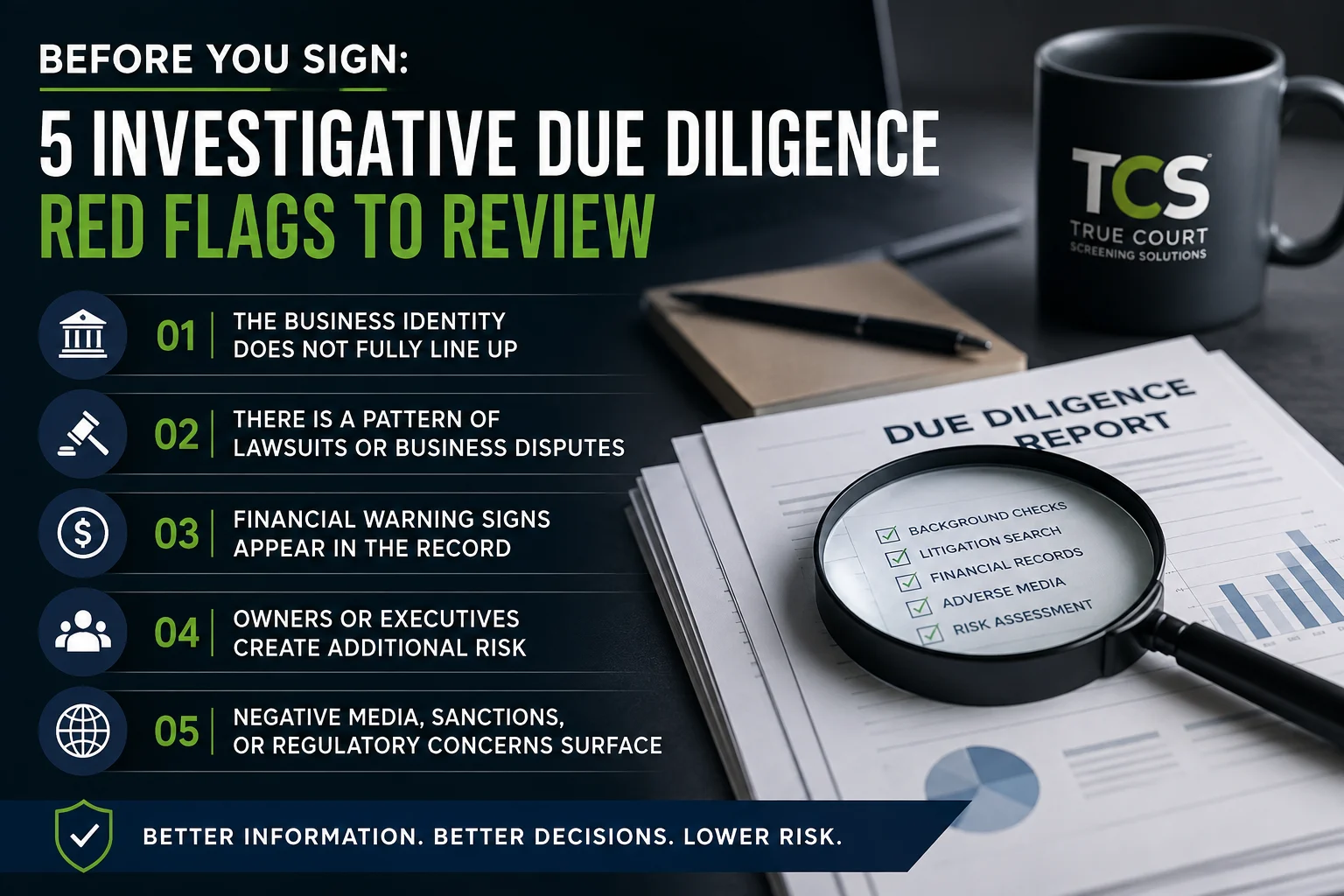
1. The Business Identity Does Not Fully Line Up
One of the first red flags in any due diligence review is confusion around the actual business identity.
A company may present one name on its website, another name on a proposal, and a different legal entity on the contract. It may operate through a DBA, affiliated company, newly formed entity, or related business that is not immediately obvious.
That does not automatically mean something is wrong, but it should be reviewed.
Investigative due diligence may help confirm the company’s legal name, entity status, formation date, registered agent, business address, and related entity information. This helps answer a basic but important question: who are you actually entering into a relationship with?
If the business is inactive, recently formed, difficult to verify, or operating under inconsistent names, that may be worth understanding before moving forward.
2. There Is a Pattern of Lawsuits or Business Disputes
Civil litigation is not uncommon in business. A single lawsuit may not be a major concern, especially if it is old, resolved, or explainable.
The bigger concern is pattern.
Repeated lawsuits involving breach of contract, unpaid invoices, customer disputes, vendor conflicts, negligence claims, partnership disputes, or allegations of misrepresentation may indicate a deeper issue. These matters can provide insight into how a company has handled prior business relationships and obligations.
Investigative due diligence looks beyond the existence of a case. It considers the type of dispute, the parties involved, the timing, the outcome, and whether similar issues appear more than once.
A business with one isolated dispute is very different from a business with repeated claims involving the same kind of problem.
3. Financial Warning Signs Appear in the Record
Financial risk is not always obvious from a proposal or sales conversation.
Liens, judgments, bankruptcies, UCC filings, and collection-related matters may reveal financial stress, creditor activity, unresolved obligations, or secured claims against business assets.
These records do not always mean a company should be avoided. Many businesses have financing arrangements, prior disputes, or older financial matters that may no longer be relevant. However, unresolved judgments, repeated liens, active bankruptcy matters, or a pattern of creditor issues may raise important questions.
Before entering a relationship, these findings may help a company decide whether to request clarification, adjust payment terms, strengthen contract protections, ask for additional documentation, or perform a deeper review.
The purpose is not to assume the worst. The purpose is to reduce surprises.
4. Owners or Executives Create Additional Risk
Sometimes the business itself is only part of the picture.
Owners, executives, principals, board members, and key decision-makers may carry their own public-record or reputational history that could matter depending on the relationship. This can be especially important when reviewing acquisition targets, investment opportunities, business partners, high-trust vendors, or companies that will have access to sensitive operations.
Investigative due diligence may identify concerns involving prior business disputes, bankruptcy history, civil litigation, regulatory issues, sanctions exposure, adverse media, or other matters connected to key individuals.
A company may look stable, but the people behind it may have a history that deserves closer review.
That does not mean every issue is disqualifying. Context matters. But when key individuals are connected to repeated disputes, financial problems, misconduct allegations, or reputational concerns, those facts may be relevant before moving forward.
5. Negative Media, Sanctions, or Regulatory Concerns Surface
Not every risk shows up in a court record.
Some warning signs appear through news coverage, trade publications, regulatory announcements, enforcement releases, sanctions lists, watchlists, or other publicly available sources.
Adverse media may reveal allegations involving fraud, misconduct, customer harm, failed projects, safety issues, executive controversy, or deceptive business practices. Sanctions and watchlist screening may identify compliance-related concerns involving a company, owner, executive, or related party.
These findings should be reviewed carefully. Negative news is not a verdict, and a potential watchlist match should not be treated as confirmed without proper review. The source, date, relevance, identifiers, and surrounding context all matter.
Still, these searches can help identify issues that may not appear in basic business filings or standard court searches alone.
Red Flags Are Signals, Not Automatic Conclusions
Investigative due diligence is not about treating every record as a dealbreaker.
One lawsuit may be explainable. One lien may have been resolved. One negative article may be outdated or incomplete. A business may have gone through a prior bankruptcy and later recovered. A company may have changed ownership, improved operations, or resolved past disputes.
The value of due diligence is in understanding the full picture.
When multiple indicators point in the same direction, they may reveal a pattern that deserves attention. That pattern may help a company ask better questions, negotiate stronger contract terms, require additional documentation, modify the relationship, or decide not to move forward.
Good due diligence does not replace business judgment. It supports it.
How True Court Screening Solutions Can Help
True Court Screening Solutions helps businesses, investors, advisors, and organizations conduct investigative due diligence before important business decisions are made.
Depending on the scope of the request, our research may include business entity verification, civil litigation searches, criminal public records where appropriate, bankruptcy records, judgments and liens, UCC filings, sanctions and watchlist screening, adverse media research, executive due diligence, and other public-record checks.
Whether you are reviewing a vendor, contractor, executive, business partner, supplier, acquisition target, or other third party, investigative due diligence can help provide a clearer picture before you move forward.
Before you sign the agreement, it is worth knowing whether the full story supports the decision.