A business can look perfectly fine on paper. Its entity may be active, its website may look professional, its proposal may be polished, and its references may sound strong. There may be little or no obvious litigation history, no immediate sanctions concern, and nothing in the basic public record that appears alarming at first glance.
But that does not always mean the full risk picture is clear.
Sometimes, important warning signs appear in public reporting before they appear in court records, business filings, or formal enforcement actions. A company may be facing customer complaints, regulatory scrutiny, executive controversy, safety concerns, allegations of misconduct, or reputational issues that have not yet resulted in a lawsuit or government action. Those issues may still matter when deciding whether to work with a vendor, contractor, executive, business partner, acquisition target, or other third party.
That is where adverse media searches can add value.
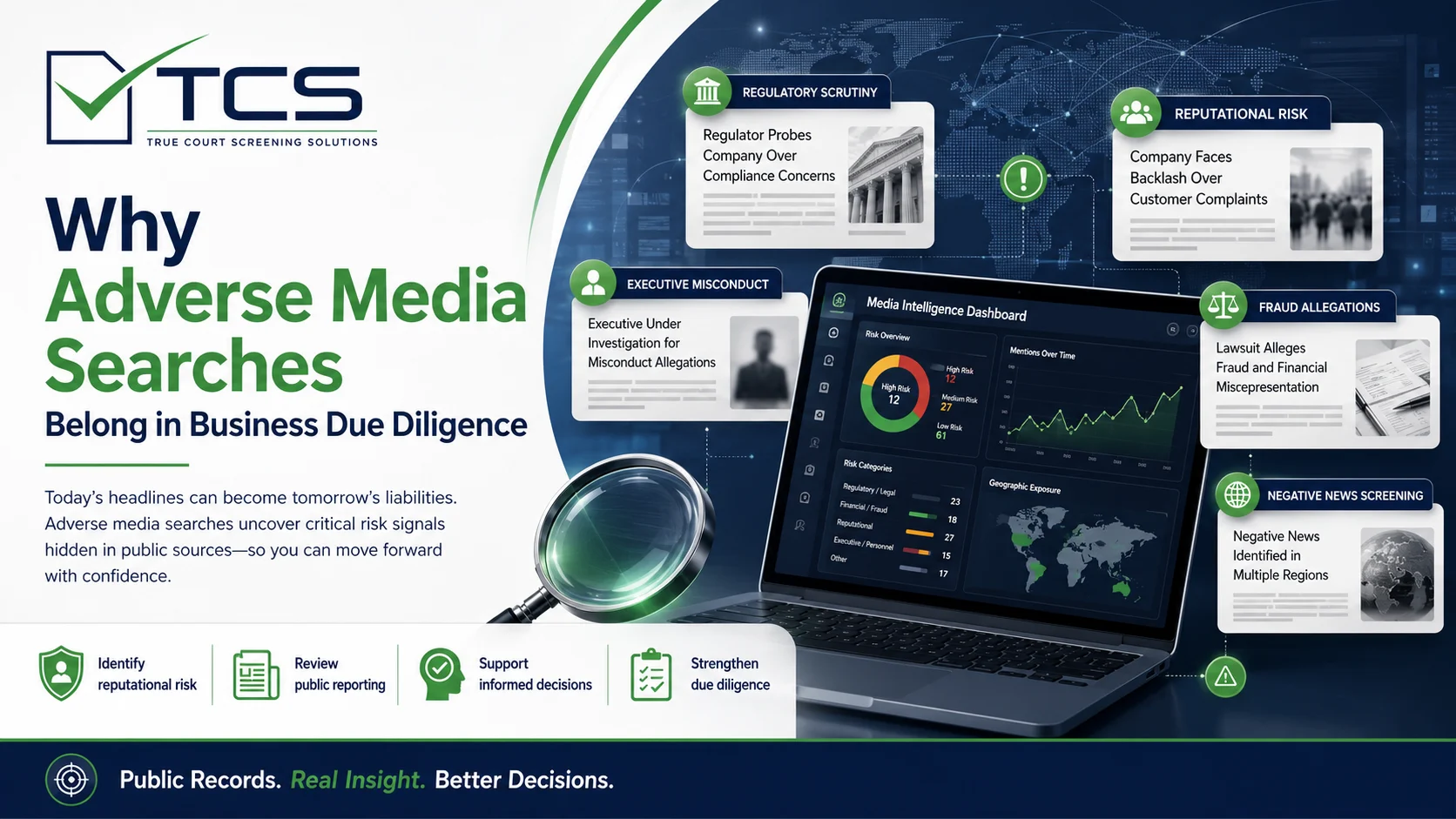
Adverse media refers to negative or risk-related public information reported through news articles, trade publications, regulatory announcements, press releases, online reports, and other publicly available sources. It may involve fraud allegations, executive misconduct, regulatory concerns, consumer complaints, failed projects, financial instability, sanctions exposure, data security issues, or other reputational matters.
The purpose of an adverse media search is not to assume that every negative mention is accurate or meaningful. Public reporting can be incomplete, outdated, one-sided, or based on allegations that were never proven. Instead, the purpose is to identify potential concerns so they can be reviewed in context before a business relationship begins.
Not Every Risk Shows Up in a Court File
Traditional public-record due diligence often focuses on business registration, civil litigation, liens, judgments, bankruptcies, sanctions, and other formal records. Those searches are important, but they do not always capture reputational or operational concerns that may already be visible in the public domain.
For example, a company may not have a major civil litigation history, but media reports may show repeated customer disputes, regulatory attention, failed contracts, safety incidents, or allegations involving leadership. Another company may have clean registration records but a pattern of negative reporting that raises questions about how the business operates.
In those situations, adverse media can help fill the gap between what appears in formal records and what may already be publicly known.
This can be especially useful before entering relationships that involve trust, access, reputation, or financial exposure. Vendors may have access to facilities, customer information, financial systems, confidential data, or critical operations. Executives and business partners may influence reputation, investor confidence, and long-term strategy. Acquisition targets may come with public concerns that are not immediately obvious during initial discussions.
Adverse media helps decision-makers ask better questions before moving forward.
Negative News Should Be Reviewed in Context
A negative article or public report should not automatically be treated as a final conclusion. The key is context.
Decision-makers should consider the source of the information, the date of the report, whether the issue was resolved, whether the subject was directly involved, and whether the information is supported by court records, regulatory filings, or other public sources. It is also important to determine whether the result involves the correct company or individual, especially when similar names, related entities, trade names, former names, or affiliated businesses are involved.
One isolated article may not be significant. A pattern of reporting around the same concern may be more meaningful.
For example, repeated reports involving customer harm, fraud allegations, executive misconduct, failed projects, regulatory scrutiny, or financial instability may indicate a broader risk pattern. Even if none of those stories alone would stop a business relationship, together they may help a company decide whether to ask more questions, request additional documentation, strengthen contract protections, or reconsider the relationship.
This is why adverse media works best as a signal, not a verdict. It helps identify areas that may deserve deeper review.
Why Basic Internet Searching Is Not Enough
A simple internet search may be a useful starting point, but it is not the same as structured adverse media research. Search results can be incomplete, inconsistent, outdated, or influenced by rankings that do not necessarily reflect risk relevance. Important information may appear under an alternate company name, an owner’s name, an executive’s name, a former business name, a trade name, or a related entity.
At the same time, basic searches can produce false positives or unrelated results. A company or individual with a common name may be confused with someone else. An old article may no longer be relevant. A negative mention may lack enough detail to connect it to the subject being reviewed.
That is why human review matters. The goal is not just to find negative information. The goal is to determine whether the information is relevant, current, credible, and connected to the business decision being made.
Adverse media should also be viewed as part of a broader due diligence process. Entity verification can help confirm who the business is. Litigation searches can identify formal disputes. Bankruptcy, lien, judgment, UCC, and sanctions searches can reveal financial, legal, and compliance concerns. Adverse media adds another layer by identifying public concerns that may not yet appear in formal records.
Together, these searches can provide a more complete view of potential risk.
How True Court Screening Solutions Can Help
True Court Screening Solutions helps businesses, investors, advisors, and organizations evaluate public-record and reputational risk before important business decisions are made.
Depending on the scope of the request, our research may include adverse media searches, business entity verification, civil litigation searches, criminal public records where appropriate, bankruptcy records, judgments and liens, UCC filings, sanctions and watchlist screening, and other public-record checks.
Whether you are reviewing a vendor, contractor, executive, business partner, acquisition target, supplier, or other third party, adverse media research can help bring important issues to light before a relationship begins.
Public records and media coverage may not tell the entire story, but they can reveal issues worth knowing before you move forward.