Businesses often rely on vendors, contractors, consultants, suppliers, and third-party service providers to support daily operations. These relationships can be valuable, but they can also create risk.
A vendor may have access to company facilities, customer information, financial systems, confidential data, employees, clients, or key business operations. Because of that, choosing the wrong vendor can lead to financial loss, reputational harm, operational disruption, compliance concerns, or legal exposure.
That is why vendor due diligence is an important step before entering into a business relationship.
What Is Vendor Due Diligence?
A Vendor due diligence is the process of reviewing a company or individual before doing business with them. The goal is to better understand who the vendor is, whether the business is legitimate, and whether there are public-record or reputational issues that should be considered before moving forward.
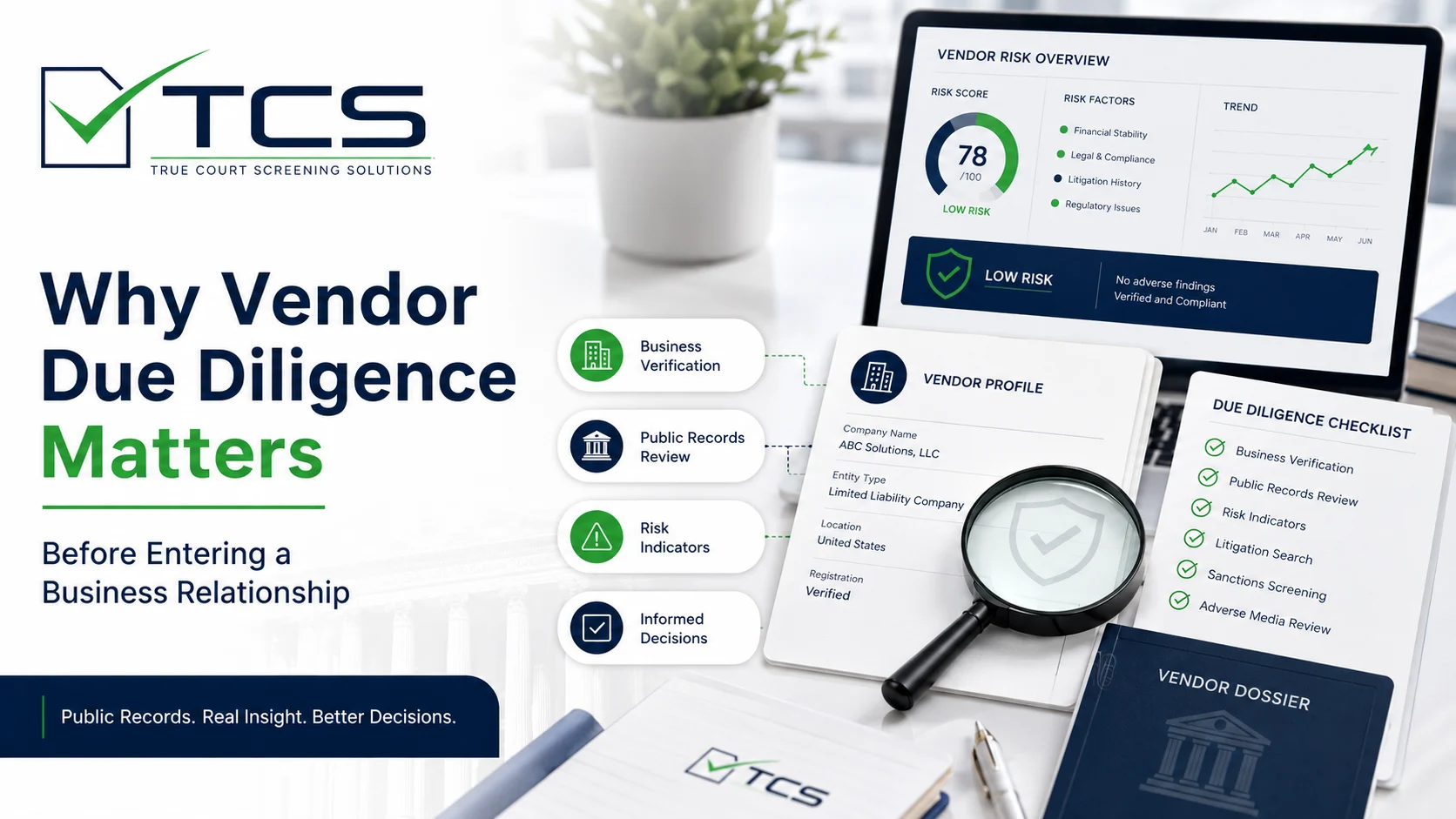
Vendor due diligence may include reviewing:
- Business registration and entity information
- Ownership or executive information
- Civil litigation history
- Criminal public records, where appropriate
- Bankruptcy records
- Judgments and liens
- UCC filings
- Sanctions and watchlist records
- Adverse media
- Regulatory or compliance-related concerns
- Other public-record risk indicators
The purpose is not to automatically disqualify a vendor because a record exists. The purpose is to help organizations make more informed decisions before relying on a third party.
Why Vendor Relationships Create Risk
Many vendor relationships go beyond a simple purchase of goods or services. In some cases, vendors become closely connected to a company’s operations.
A vendor may provide IT support, accounting services, transportation, staffing, property maintenance, security, consulting, marketing, data processing, or other important services. Depending on the relationship, the vendor may interact with customers, access sensitive information, enter private facilities, or represent the company in some capacity.
When a vendor fails to perform, acts dishonestly, becomes financially unstable, or brings unresolved legal problems into the relationship, the company that hired the vendor may be affected.
That is why basic trust is not always enough. Businesses should take reasonable steps to understand who they are working with before the relationship begins.
What Vendor Due Diligence Can Reveal
A vendor may appear professional on the surface. They may have a polished website, strong sales materials, and positive references. However, public records may reveal a more complete picture.
Vendor due diligence can help identify issues such as:
- A business that is not properly registered or active
- Repeated lawsuits involving customers, vendors, or business partners
- Unpaid judgments, liens, or collection-related matters
- Bankruptcy history or financial distress indicators
- Sanctions, watchlist, or regulatory concerns
- Negative media involving fraud, misconduct, or business disputes
- Ownership or executive issues that may affect the relationship
A single record does not always mean there is a serious problem. However, repeated issues or a pattern of similar concerns may be important when evaluating risk.
Why Basic Online Research Is Not Enough
A quick internet search can be useful, but it has limits.
Online searches may miss court records, business filings, liens, bankruptcies, or older adverse media. Search results can also be incomplete, outdated, or difficult to verify. In some cases, different companies or individuals may share similar names, which can lead to incorrect assumptions.
Vendor due diligence requires more than simply checking a website or reading online reviews. It often requires reviewing multiple public-record sources, confirming identifiers, and understanding the context of any findings.
This is especially important when the vendor will provide high-risk services, handle confidential information, access company systems, or perform work that could impact customers or operations.
Vendor Risk Is About Patterns
The value of vendor due diligence is not only in finding records. It is in understanding what those records may mean.
For example, one civil lawsuit from several years ago may not be significant. Many businesses become involved in disputes at some point. But multiple lawsuits involving unpaid invoices, breach of contract claims, negligence allegations, or repeated customer disputes may suggest a pattern worth reviewing.
The same is true with liens, judgments, bankruptcies, or adverse media. One issue may have a reasonable explanation. A repeated pattern may raise more serious questions.
Vendor due diligence helps businesses look beyond isolated records and consider the broader risk picture.
When Vendor Due Diligence Is Especially Important
Vendor due diligence may be useful in many business situations, but it is especially important when the vendor will have access to sensitive areas of the business.
Examples include vendors that provide:
- Technology or IT services
- Financial, accounting, or payment-related services
- Security services
- Property management or maintenance services
- Staffing or recruiting support
- Transportation or logistics services
- Consulting or advisory services
- Data processing or document handling
- Services involving customer interaction
- Services involving access to private facilities
The more access, responsibility, or trust involved in the vendor relationship, the more important it becomes to understand the vendor’s background and public-record profile.
Public Records Help Support Better Business Decisions
Public records do not always tell the entire story, but they can reveal issues that may not be visible during the sales process.
A company may discover that a vendor has a history of litigation, unpaid obligations, bankruptcy activity, regulatory concerns, or negative media. That information may not automatically end the relationship, but it can help the company ask better questions, negotiate stronger contract terms, require additional documentation, or decide whether another vendor is a better fit.
The goal is not to create unnecessary obstacles. The goal is to reduce surprises.
How True Court Screening Solutions Can Help
True Court Screening Solutions provides public-record and due diligence research to help businesses evaluate vendors, contractors, executives, business partners, and other third parties before important decisions are made.
Depending on the scope of the request, our research may include business entity verification, civil litigation searches, criminal public records, bankruptcy records, judgments and liens, UCC filings, sanctions and watchlist screening, adverse media research, and other public-record checks.
Vendor due diligence gives businesses a clearer picture before entering into a relationship. In today’s business environment, knowing who you are working with is not just a good practice. It is a smart risk management step.